

Asimov Cascade
Predictions from 2025 and older

Remember the number 1 rule of Wall Street?
Nobody - I don’t care if you’re Warren Buffett or Jimmy Buffett - Nobody knows if the stock’s going to go up, down, sideways, or in fucking circles, least of all stockbrokers. It’s all a Fugazzi. You know what a Fugazzi is?
Your inbox is full of 2026 predictions.
Hell, I got a text message from my gardener around his weather predictions last week. Everyone has a take now.
Nobody knows. Nobody knows what crypto prices will be. Nobody knows if it is priced in. Nobody knows what AI will do in 2026.
So focus on what you already know.
There is a word going around the web right now: Slop.
Slop is the blogpost with emdashes in it.
The purple gradient landing page. Big buttons. Stock photos of people shaking hands.
More and more of it. Every day.
This is an Asimov Cascade.
1. Use AI to launch more AIs
2. AIs produce more output
3. More output means more for other AIs to discover
4. Which launches more AIs to produce more similar things
Copies of copies of copies. Chain reaction. No off switch.
People call this a problem. Where does it end? Are we stuck with an ever degrading pile of products and content? Copies of copies forever?
I keep asking myself: Is it actually a problem?
No. It is the feature.
Bezos has this famous interview. The idea is that he did not know what the future held. E-commerce could have been just a fad.
However he knew some things that the past. Things that mattered - for sure, with 100% confidence.
People will not want slower delivery
People will not want to pay more
People will not want less selection
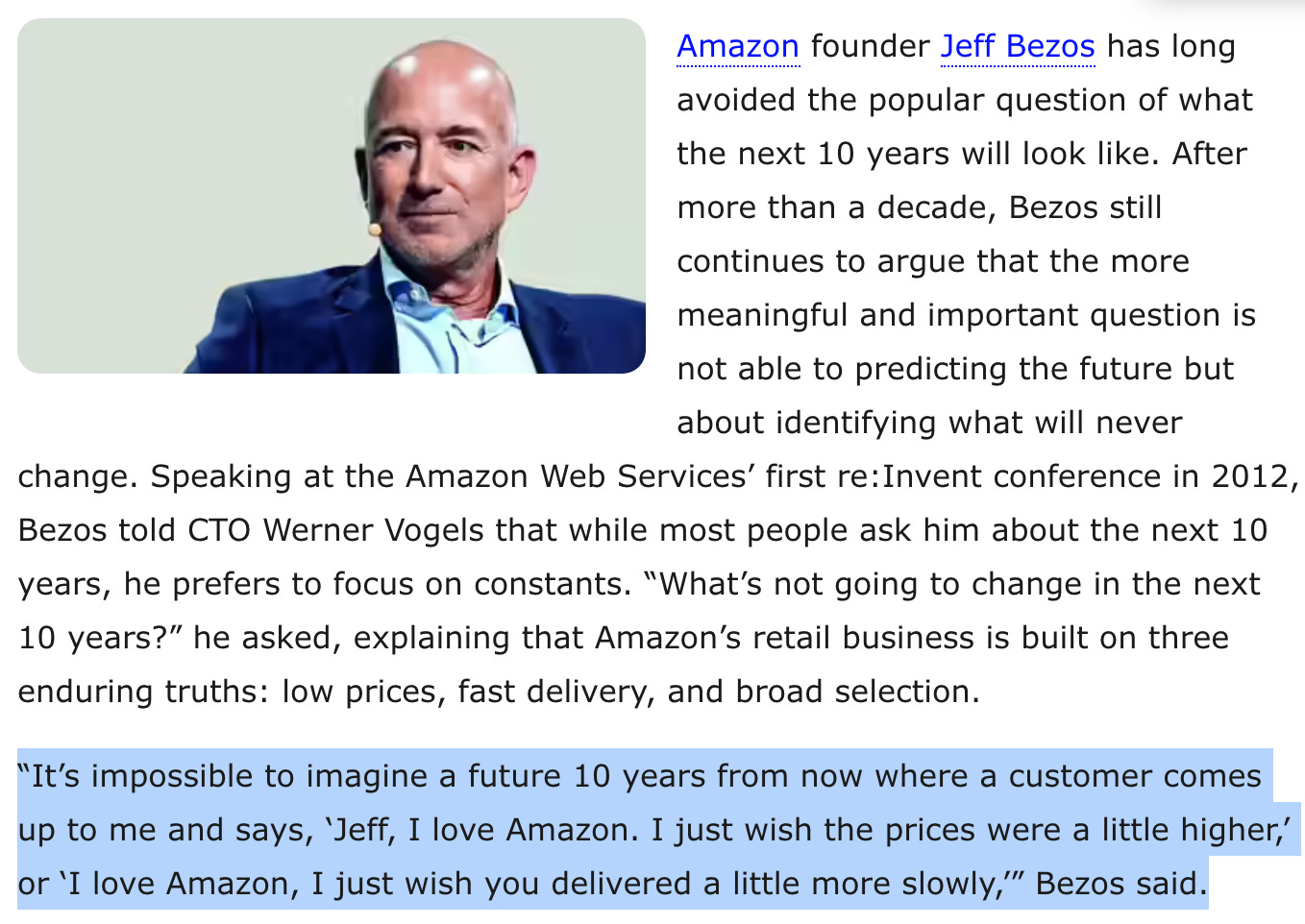
So he focused on nailing down what he for sure knew people would want.
Take Wall Street.
The richest people and the best firms in Wall Street are not stock pickers. They are market makers.
They simply facilitate fills of orders so each lot can be sold and bought instantly.
Surprise: that is what people always wanted. Liquid, wet money.
Which brings me back to tech and AI.
What do we know about AI?
Nothing. Well, I don’t. I am not some fancy researcher.
So I have to approach things in a pragmatic way.
Let me reframe the question:
Where does AI have product market fit?
This is more up my alley. Here we go:
Coding
Legal work
Companionship
Photoshopping
Surely you could add more - because you work on something other than these areas that will be the next trillion dollar company.
Sure. Humor me for a second.
If I had to put all my chips on one, it would be coding.
Why?
Because legal work is actually coding. You grep some legislation, you read some precedents, you write or better said, code, some output document.
Companionship is the same. Pattern matching on conversation history. Retrieving context. Generating responses.
Photoshopping? Maybe not. Though I don’t much care yet because I hardly take selfies. So why bother now?
There are two takes in the market right now:
AI is the biggest platform shift ever. Like mobile. Like cloud.
There are no new experiences. Nothing has changed.
I disagree with both.
Here is what I see:
AI is still single player. You and a chatbox.
The big social networks are the same ones from before AI.
Most B2B software looks the same. They just added “AI-powered” to the homepage.
VCs push the platform narrative because they need a story but AI is not a new distribution network like mobile was. It is a new way to compute.
When in fact, AI does have a killer experience. It already exists. It is just not evenly distributed.
Vibe coding.
Or if you are a serious engineer: vibe engineering.
The cascade, the copy-of-copy, is the vice of this generation of tech.
It also is the benefit.
Just as social media made information accessible while also brainwashing us.
This time around there is no killer app. The next Facebook. The next Uber. Some new thing that will crush everything else and define the era.
Because the killer app is not an app. It is the ability to make apps.
The feature of AI is not some single company building a better product than everyone else. You give it a computer. You tell it what to build. It builds.
If it looks bad, doesn’t work or is illogical - it is your own fault. So is its usefulness.