

The only startup rule that works
Be clear. Even if you're clearly wrong, be clearly wrong.

Running Godmode taught me something painful. Something simple. Something most founders miss completely.
Here's the truth: These rules are garbage.
Well, not garbage exactly. But they're circumstantial. For every rule, I'll show you a company that broke it and won anyway.
Take Cursor. Worth $500 million now. The founder admits they started as a solution looking for a problem. That breaks rule number six right there. (watch from 12:50 in the video below)
But there's one rule that never breaks. One rule I've never seen fail. It's harder than it sounds. Rarer than you think.
Clarity.
Most founders I know are smart. You're smart too. You're probably working in some big market with perfect founder-market fit. Your engineers build AI-native products because who doesn't these days?
But answer these three questions honestly:
What do you do? Clearly.
Who is your competition? Clearly.
Does your team know what to do, right this second? Clearly.
What do you do? Clearly.
Can you explain your company in one breath? If you shouted it at someone in a crowded room, would they get it? Or do you need three minutes to explain the problem you solve?
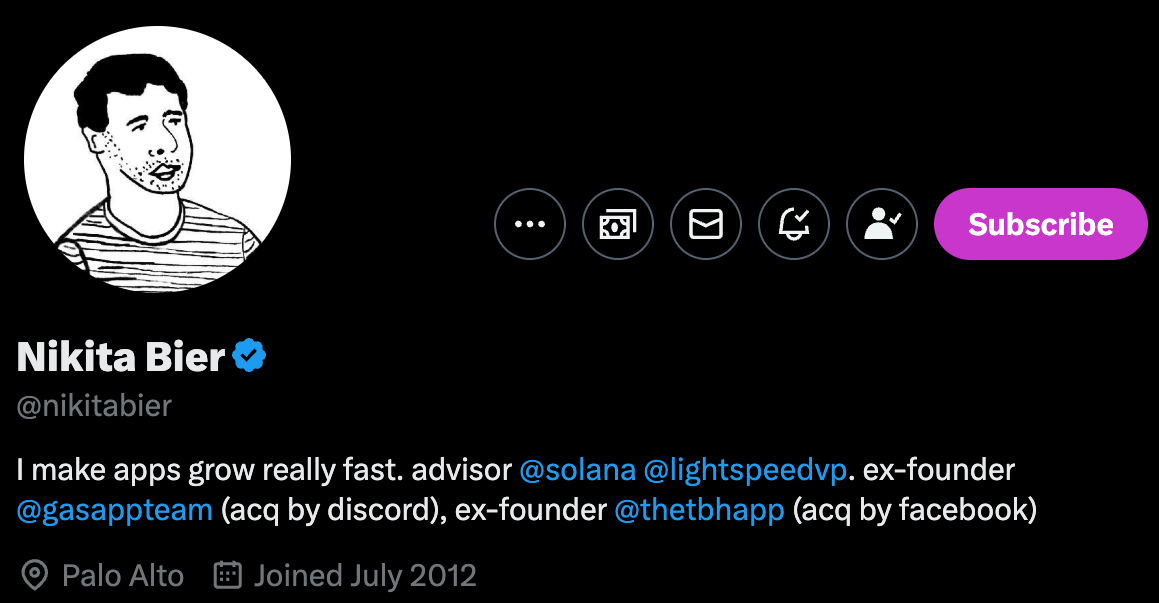
Look at Nikita Bier's Twitter bio. "I make apps grow really fast."
That's it. Nothing else.
No bullshit about why distribution beats product. No secrets that regular people don't know. He makes apps grow really fast.
What's your equivalent?
Who is your competition? Clearly.
We all want to create new categories. Invent industries. Dominate virgin markets.
This is bullshit.
Investors love these stories because they sound better. They make for better pitch decks. But customers don't care if you created an industry. They care if you solve their problem better than what they use today.
Circle isn't "internet money that never existed." It's a bank. It holds your money and gives you access to currency you couldn't get yourself.
Uber isn't "the gig economy sweetheart." It's a taxi company that works better than taxis.
Figma didn't create design software. Adobe existed for years. Still bigger than Figma today.
However, all these companies have one thing in common. They attacked the problem at hand in a different way or from a different angle.
Here's the trick that works:
Find an incumbent. Find how people solve this problem today. Then solve the same problem in a better way.
If you can explain why your way beats the old way, you're clear.
Does your team know what to do?
This one nearly killed me.
Every weekend at Godmode, I felt depressed. Customers were quiet. The team needed a break. The world stopped spinning.
Monday would come. I'd have a magical new feature idea. But the idea was half-baked. Not polished. Not thought through.
The team would stare at me. "Why are we doing this?" they'd ask. "What exactly is this?" "What's the use case?"
My answers changed every time. And they were vague.
"They can use it to automate responses. Or create internal automations. Or research."
The best teammates see through this immediately. And it destroys two things:
Your credibility as a leader who knows what he or she is doing
Team morale when they're building something they don't understand
The problem isn't bad ideas. It's bad articulation.
If you say "I have a hunch this will work because of X," that's clear. Even if you're wrong, you can admit it and move on. A bet taken and lost.
But vague explanations make you look clueless. Your team loses faith. You lose momentum.
This is the hardest part because founders lose confidence all the time. You feel broken but need to appear invincible to your team. You want them to share the burden.
They can't. That's your job.
I could ask more questions. But these three will do for now.
Be clear. Even if you're clearly wrong, be clearly wrong.
Your future self will thank you.
This was a great read!